
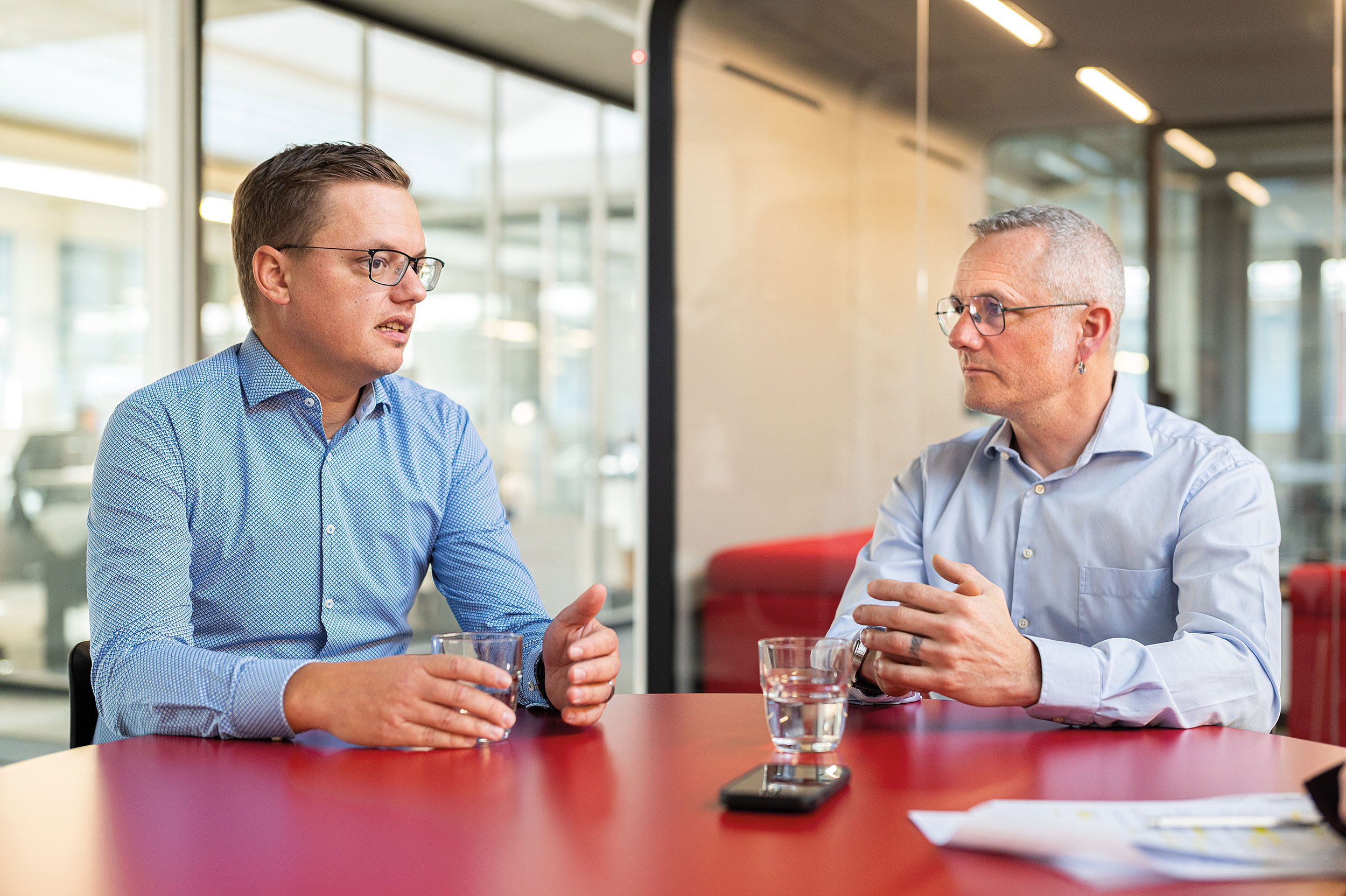
In Conversation: Raphael Ammon, Head of the Façade Construction Department at Schmid Bauunternehmung AG, and Samuel Bregenzer, Managing Director of Ecolite AG
Navigating Against the Wind
Facades have never been so diverse—or so fiercely competitive. Increasing demands, growing cost pressures, and a shortage of skilled workers. Raphael Ammon and Samuel Bregenzer describe how they’re tackling these challenges and what will shape the industry in the coming years.
Schmid Bauunternehmung and Ecolite have been working together for years—what connects your companies?
Raphael: Teamwork and mutual trust. Both sides see themselves as catalysts who deliberately position their teams and partners. I learned the trade from the ground up at Schmid Bauunternehmung and was given more responsibility step by step. That continues to shape my leadership style to this day: I nurture talent within my own company and delegate responsibility to younger employees early on. This unleashes new energy and opens up new avenues for solutions. For us, sustainable success matters more than short-term profit. In our collaboration with Ecolite, we share the same leadership principles, values, and goals. Technical challenges are addressed in a solution-oriented manner as a team, and together we can precisely accommodate every architectural detail.
Samuel: I couldn’t agree more. Our collaboration with Schmid Bauunternehmung isn’t like a traditional client-supplier relationship—it’s more like a well-oiled team. As a family-owned business, we think long-term, delegate responsibility, and support employees who are passionate about what they do. This continuity builds trust, allows business relationships to grow over the years, and leads to a shared understanding of projects. Thinking through technical issues and actively driving projects forward is in our DNA. We don’t just deliver products—we deliver solutions. With Schmid Bauunternehmung, this approach has evolved over the years. That’s what brings us together.
Facade construction is changing on several levels at once. Where is this most evident?
Samuel: Facades have become more diverse—in terms of design, technology, and function. At the same time, the challenges are growing: digitalization, a shortage of skilled workers, increasingly stringent technical requirements, and mounting cost pressures. These developments are occurring in parallel and are changing what is required of the planning and implementation phases. This makes it all the more important to broaden our horizons and work together to consider where facades are headed and what solutions are needed to meet those needs.
Raphael: We see this trend very clearly in our day-to-day work. Facade projects have become more challenging because many factors interact simultaneously during planning and execution, and the overall conditions are constantly changing. It is therefore crucial to maintain close communication—both internally and with external partners—and to continue developing solutions together.
The market is shifting from new construction to renovation—what does that mean specifically for your work?
Raphael: In terms of execution, renovations are usually more challenging than new construction. With existing buildings, it’s often not until the facade is opened up that you see what’s actually behind it. Added to this are tight spaces, complex logistics, and work carried out in phases—often while the building remains in use. This makes planning and cost estimation more difficult. That makes it all the more important to have partners who can respond flexibly and adapt solutions to the situation on the construction site.
Samuel:The particular challenge with renovations lies in the existing structure, because no two buildings are alike. You encounter old materials, uneven structures, unknown substrates, or asbestos. At the same time, you have to take into account the existing window placements and structural requirements. Planning therefore often works only as an ongoing process, because details can only be clarified during the construction phase. Nevertheless, renovations will become more common, not least because they are more sustainable than new construction.
What requirements must facades meet today?
Raphael:In Switzerland, we’re seeing a strong trend toward individualization. Building owners want to deliberately set their buildings apart from others and place a high value on unique solutions. This is reflected in the choice of materials, the architectural design, and, increasingly, in sustainability requirements. We address these challenges through standardized processes and efficient work planning, among other measures. Nevertheless, the risks remain high, not least because of labor costs in Switzerland. We are challenged to provide the client with an attractive offer while also operating cost-effectively.
As a system partner, how do you meet this requirement?
Samuel:We combine individual requirements with solutions that are as standardized as possible. New materials, manufacturing technologies such as CNC processes, photovoltaic facades, and sustainable concepts expand our scope of possibilities. We see ourselves as enablers: we take all requirements into account and use them to develop a technical, economical, and aesthetic solution. Our systems are usually just the starting point. The real work lies in the project-specific details.
Costs and margins are under pressure. How do you ensure profitability without compromising on quality?
Raphael:It starts with project selection. We assess early on which projects are a good fit for us. Complex projects require a significant amount of planning and coordination, and that is precisely where our core expertise lies. Whenever possible, we work with our own staff and long-standing partners. This reduces coordination issues and allows us to execute projects efficiently and with consistently high quality.
Samuel:For us, efficiency stems primarily from collaborative technical optimization. This begins with structural analysis, continues with adjusted bracket spacing, and extends to solutions that simplify installation. The key is to design the system with the installation process in mind. In many cases, the biggest factor affecting costs isn’t the material itself, but the installation time on the construction site. That’s exactly where we come in—we develop solutions that can be implemented more quickly and easily.
Many people expect digitalization to lead to efficiency gains. Are these expectations justified?
Samuel:Digitalization is an important tool, but it’s not a panacea. In 3D planning, building scans, and production, it offers clear advantages and makes processes more efficient. In renovation projects, however, it reaches its limits because many conditions only become apparent during the construction process. Digital planning is an important support tool, but it cannot replace experience and flexibility in implementation.
Raphael:We see advantages primarily in communication and planning. Changes can be coordinated more quickly, and material lists can be created more efficiently. However, this speed also carries risks. Because adjustments can be made on shorter notice, decisions are sometimes made later. On the construction site, this can disrupt workflows and lead to additional costs. It therefore remains crucial to combine digital capabilities with thorough planning and clear processes.
Samuel, you started developing your own software solutions early on. Did that pay off financially?
Cost-effectiveness alone isn’t enough for us. It’s about independence and flexibility. That comes at a price initially, but it pays off over the years because we can tailor our tools precisely to the way we work. Where others accept detours, we take the direct route. That makes us faster, and our customers benefit from it. What benefits them ultimately benefits us in the long run.
Raphael, do you collaborate with architects and general contractors more closely today than you did in the past?
So far, we haven’t seen any fundamental changes. BIM hasn’t become as widespread as was expected a few years ago. There are various solutions on the market, particularly in the BIM-to-Field sector. None of them has really caught on yet. Something else has changed, though: As projects become more complex, collaboration between architects, manufacturers, and contractors is starting earlier and earlier. I think that’s the right approach. Those who work together on solutions before and during construction keep costs low while still achieving high quality.
Will facade construction shift from the construction site to the factory floor if processes are integrated earlier?
Samuel: Modular construction will become more important, but it will not replace traditional construction. Conventional construction methods remain essential, particularly for thermal retrofits. In new construction, however, modular construction methods open up new possibilities: lightweight structures and interior insulation mean that facade systems are increasingly prefabricated and integrated into industrial processes.
Raphael: The increasing use of prefabrication primarily affects specific areas such as mullion-transom facades, in which we are only involved to a limited extent. We deliberately focus on projects with a high degree of customization. That is our strength and ensures a stable workload.
Raphael, the demands in facade construction are increasing, yet there is a shortage of skilled workers. How are you handling this?
The construction industry has been struggling with a shortage of skilled workers for years, not least because the profession isn’t well established among young people. Facade construction is also a small sector. It’s difficult to find new talent, and just as difficult to retain skilled workers who plan to build their future on the job site. This makes trial apprenticeships and direct insights into the profession all the more important. In-house training remains crucial. We have retrained specialists from related fields on several occasions. Where there was a passion for facade construction, we developed those individuals further, all the way up to management level. I consider fostering employees and delegating responsibility to be among the most important leadership tasks for ensuring the long-term viability of the business.
What about you, Samuel?
Experts who truly understand rear-ventilated facades are hard to come by. We’ve noticed this, too. That’s why we train our own staff and provide them with in-house professional development. This takes time and involves a certain amount of risk. Consequently, we can’t grow as quickly as the market would allow in every area. There’s high demand for project consulting and planning, and we could further tap into this potential. However, as long as we cannot provide these services with our usual level of quality and depth, we are consciously choosing not to offer them.
What skills will be in demand in the future?
Raphael:We’re always looking for skilled tradespeople who take pride in the final product. For our on-site management team, what counts is a combination of technical understanding, digital proficiency, and an openness to new ideas. Added to that are an entrepreneurial mindset and a willingness to take on responsibility.
Samuel:What’s needed are not so much pure specialists as generalists with a broad understanding. Those who can combine technology, business efficiency, and digital topics have an advantage. Such versatile teams are especially important for smaller companies.
Where will the facade industry be in ten years?
Samuel: Today, the facade serves two key functions: it protects the building and defines its appearance. However, it is increasingly taking on additional roles as well. Green facades, solar panels, and smart materials demonstrate what is already possible. It is difficult to predict today what new solutions will emerge and which technologies will prevail in the long term.
Raphael:Material trends will continue to shape development; they come and go in waves. Circular construction and the reusability of materials are gaining importance, as are regional products to an increasing extent. No fundamental changes are on the horizon yet.
Finally: What excites you about facade construction, and what do you hope to achieve in the coming years?
Raphael: Even after all these years, I’m still fascinated by how a good facade is created. My vision is a team whose skills complement one another, whose members support one another, and who enjoy their work. In the end, it’s the people and what they create together that matter.
Samuel:We live in a designed environment, and people perceive it first with their eyes. For me, the appeal of our work lies precisely where aesthetics and technology intertwine to create a harmonious whole. No one can achieve this alone. At every point of contact, there are partners, suppliers, and customers who share the same standards, and it is our job to nurture this network.
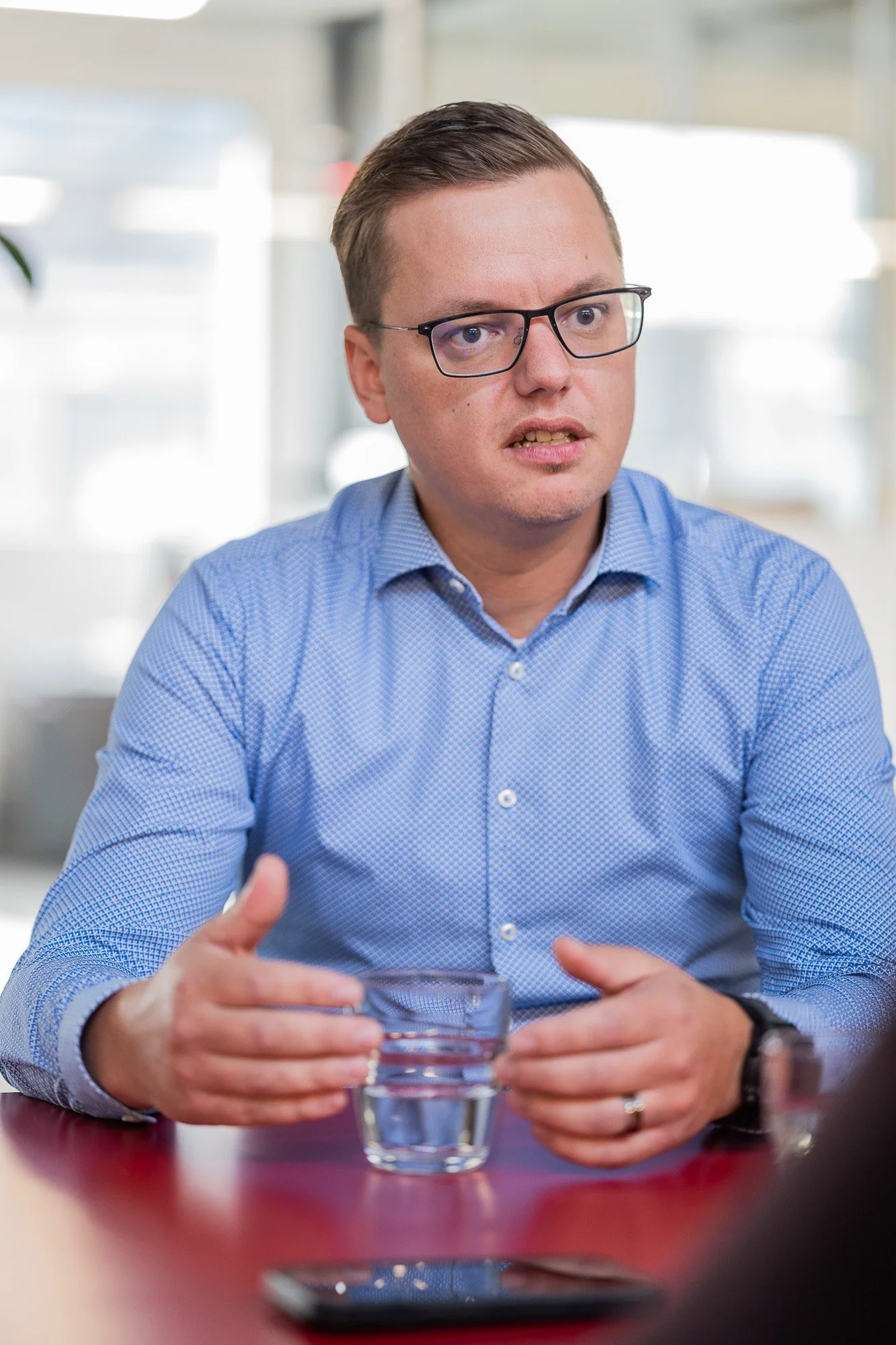
“For us, long-termsuccess matters more than short-term profit. In our partnership with Ecolite, we see that they share the same leadership principles, values, and goals.”
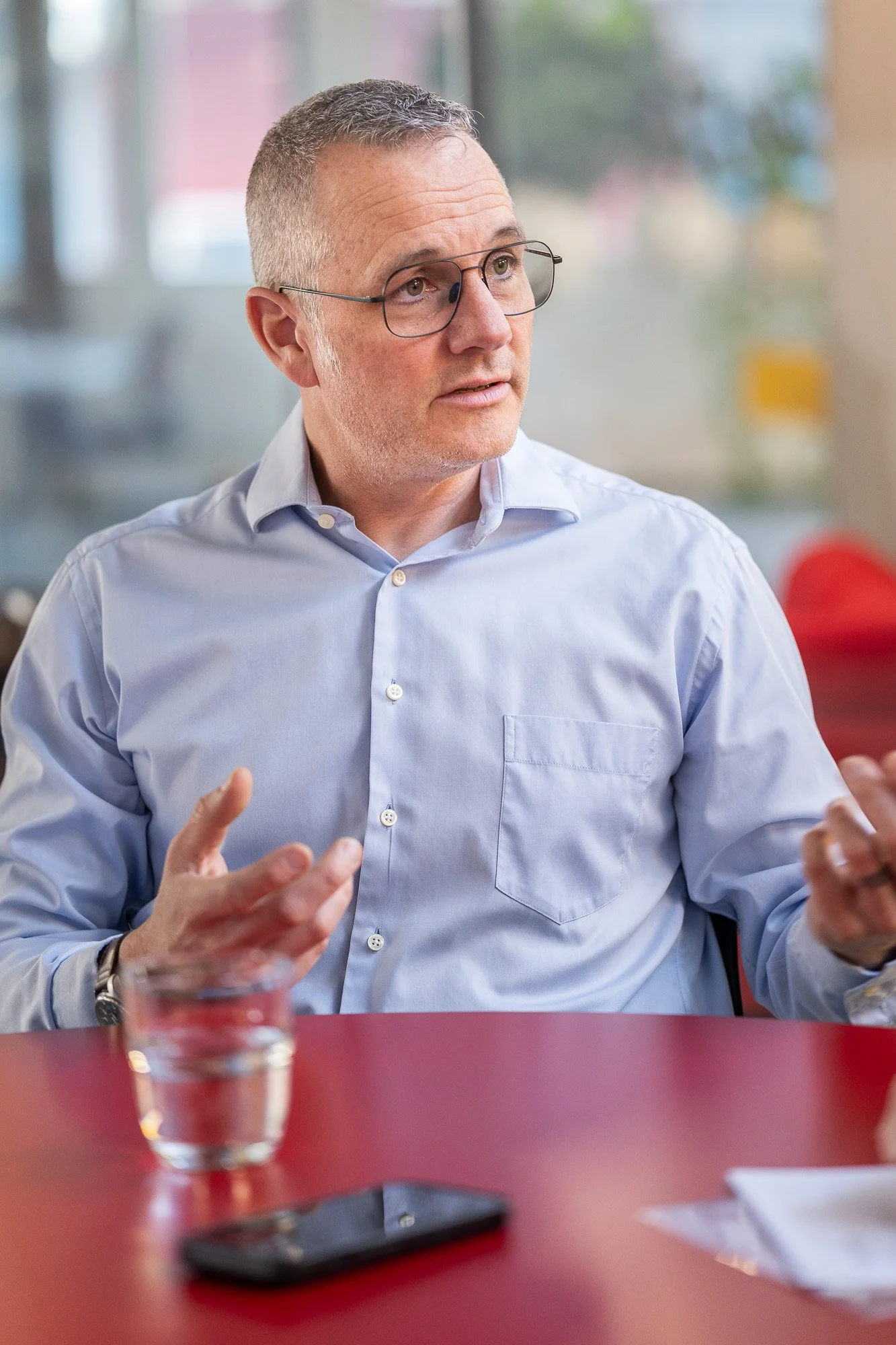
“Wesee ourselves as facilitators; we take all requirements into account and use them to develop a technical, economic, and aesthetic solution.”
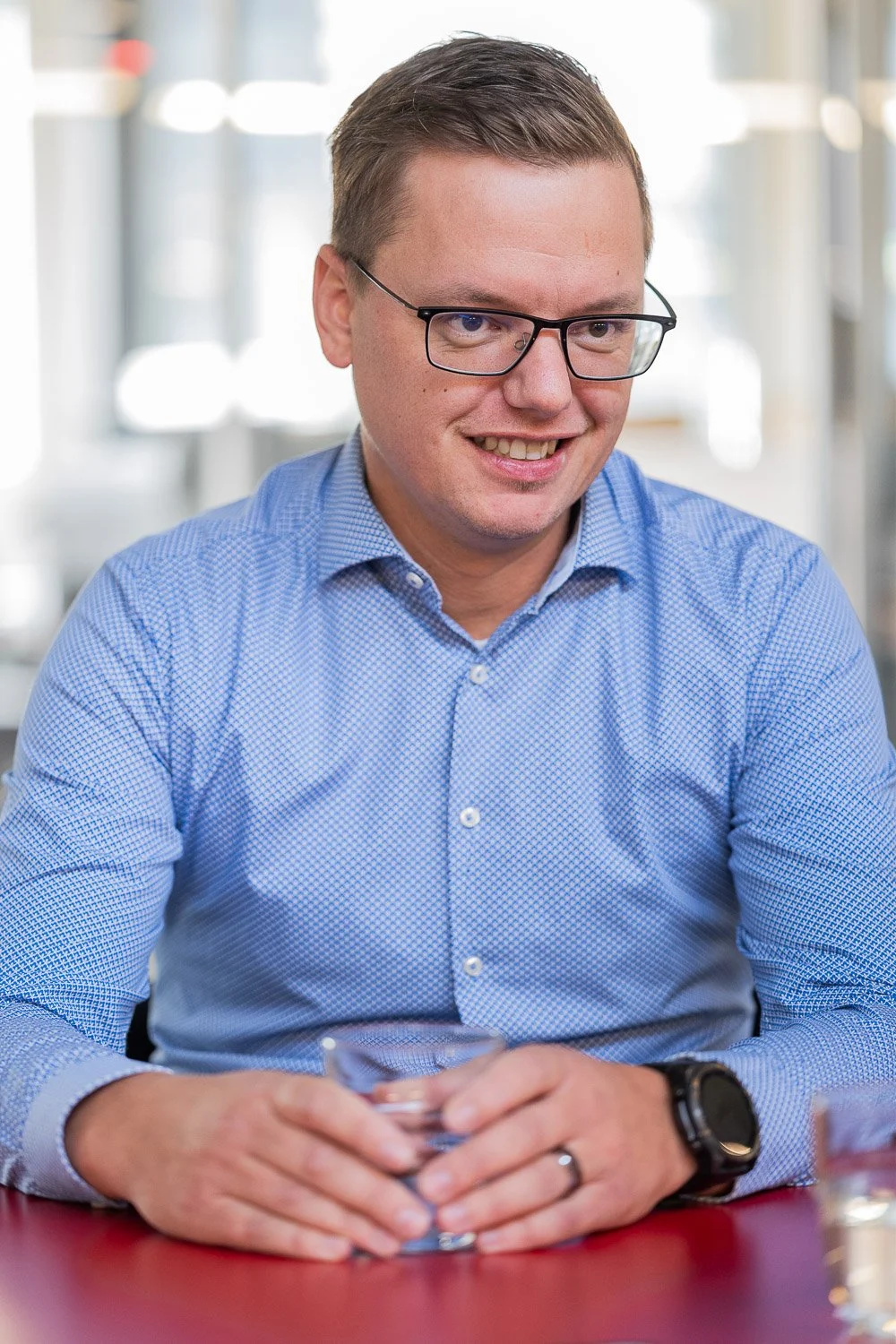
“Building ownerswant to stand out with customized solutions in architecture and material selection. We meet high standards with efficiency.”
“We’re looking forgeneralists who can bridge the gaps between technology, business, and the digital world. Smaller companies, in particular, benefit from versatile teams.”